Enterprise Document Infrastructure
Stop rebuilding document pipelines.
Docsfra turns PDFs, scans, emails and audio into structured, searchable, evidence-backed AI data — markdown, JSON, tables, entities, graphs, embeddings, search and RAG from a single upload. Built for banks, insurers, legal and enterprise AI teams that can't afford a hallucinated answer.
01 — The old way
Every AI project rebuilds the same stack.
- 01Pick an OCR provider
- 02Write a PDF parser
- 03Clean up the markdown
- 04Fix table extraction
- 05Build chunking logic
- 06Choose an embedding model
- 07Wire up a vector database
- 08Write a search endpoint
- 09Orchestrate RAG
- 10Add a citation layer
- 11Produce an audit trail
- 12Re-test all of it when the model changes
The Docsfra way
Or: upload once.
Upload once.
Get one evidence-backed representation.
Use every artifact through one API.
The 12 steps become an API call. When you swap models, nothing re-processes.
02 — Proof
One real document. Every figure below came out of it.
A representative 95-page scanned trade-finance packet — a letter of credit with its invoices, packing and weight lists, certificates of origin, insurance policies and bills of lading, merged into a single file. The counts below come from real processing; the document's identifiers are anonymized for confidentiality.
scanned pages in one merged TIFF
sub-documents separated automatically
reasoning claims — 100% verified
tables extracted
entities · 15 linked relationships
retrievable chunks
How it split the packet
A 95-page scan, separated into the documents a reviewer actually works with — each with its own page range.
03 — The intelligence layer
It doesn't summarize the document. It reasons over it — and proves every claim.
The reasoning layer turns a document into typed, checkable statements — obligations, conditions, deadlines, prohibitions, definitions, procedures, amount rules. Each one is anchored to a word-for-word quote from the page. A verification pass then re-reads the source and drops anything it cannot find, verbatim.
Reasoning claim
MATURITY DATE: 2026-09-15
Verbatim quote — page 1
verified · page 1
The hallucination shield
A claim without a matching quote never ships. On this L/C, 89 claims survived verification — every single one traceable to an exact quote on an exact page. Not a paraphrase. Not a guess.
The typed taxonomy, counted on this document
89 verified claims, sorted into type.
04 — Reads it right
The same field, read two ways — caught, not quietly corrected.
Across a 95-page scan the same number gets read differently on different pages. Docsfra folds every mention into one entity, keeps the competing readings, scores its confidence, and flags what a human should confirm. Nothing is silently overwritten.
Flagged for review
Resolved with full confidence
Letter of credit
LC-2024-0417
Amount
USD 248,500.00
SWIFT code
MRDCGB2LXXX
Applicant bank
Meridian Commercial Bank
You see the conflict, the confidence and the page — you decide. The machine never guesses on your behalf.
05 — What you get
Everything, generated from one upload.
Eight representation layers. Sixteen-plus derived artifacts. One deterministic pipeline.
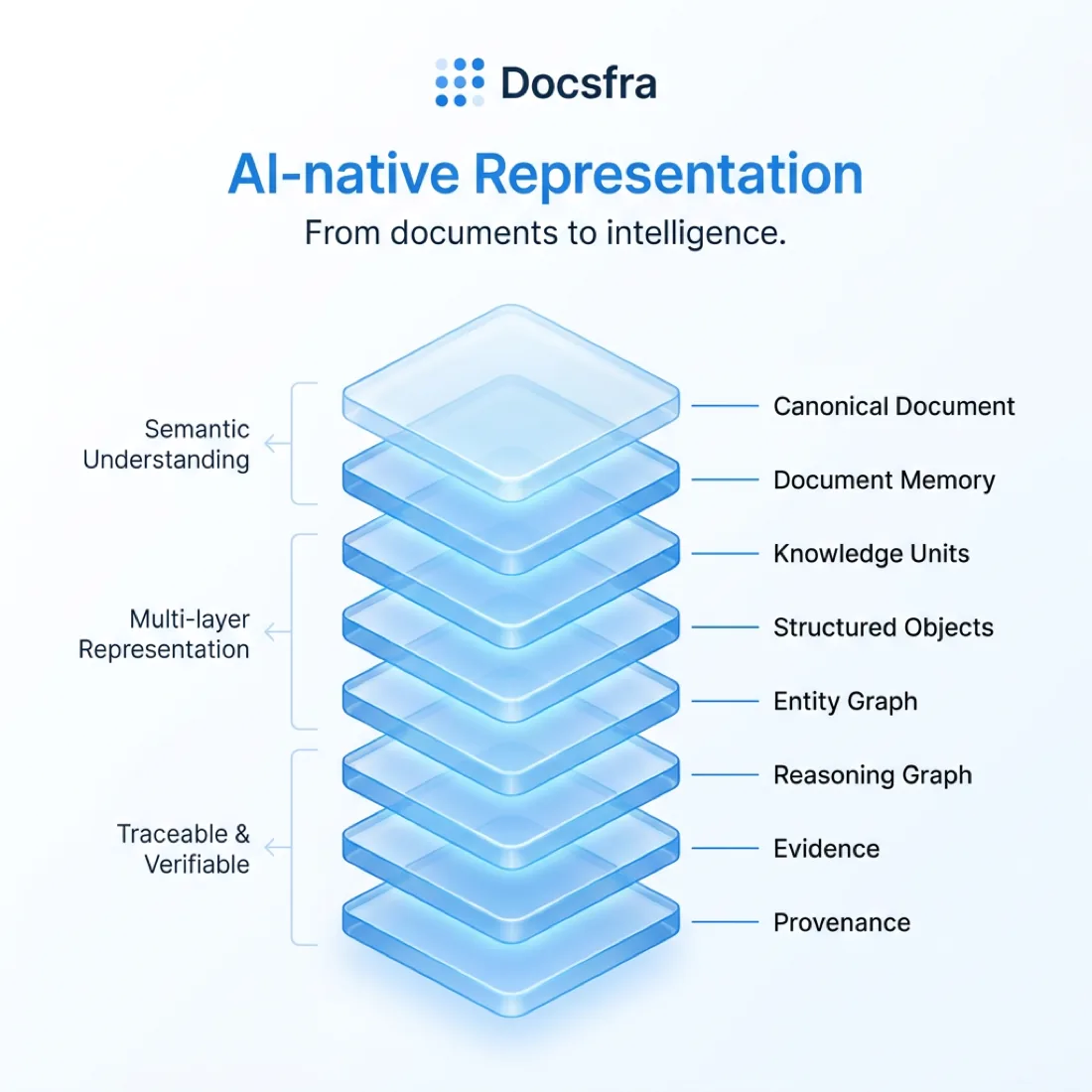
One source of truth for every AI system.
Canonical document
Immutable source representation all AI assets derive from.
Tables you can actually use.
Structured objects
Tables, clauses, figures and domain objects.
Who, what, when — connected.
Entity graph
People, companies, dates, obligations and relationships.
Ask why, not just what.
Reasoning graph
Deterministic relationships between every derived unit.
Every answer proves itself.
Evidence layer
Page, span and pixel coordinates behind every answer.
Find it, ask it, extract it.
Hybrid retrieval
Embeddings, search, ask and extraction APIs built in.
Versioned by design.
Immutable storage
Original assets, versions and CDN-ready renditions.
Never re-index again.
Model independent
Self-hosted, air-gapped or GPU-ready — swap LLMs and embeddings without a re-index.
Zero pipeline to maintain.
One upload
Everything generated from a single deterministic pipeline.
06 — How it works
From raw documents to enterprise-ready AI, in one deterministic pipeline.
One idea, end to end: understand once, represent forever, derive everything. Raw documents flow through a single representation engine that generates every AI asset your applications need.
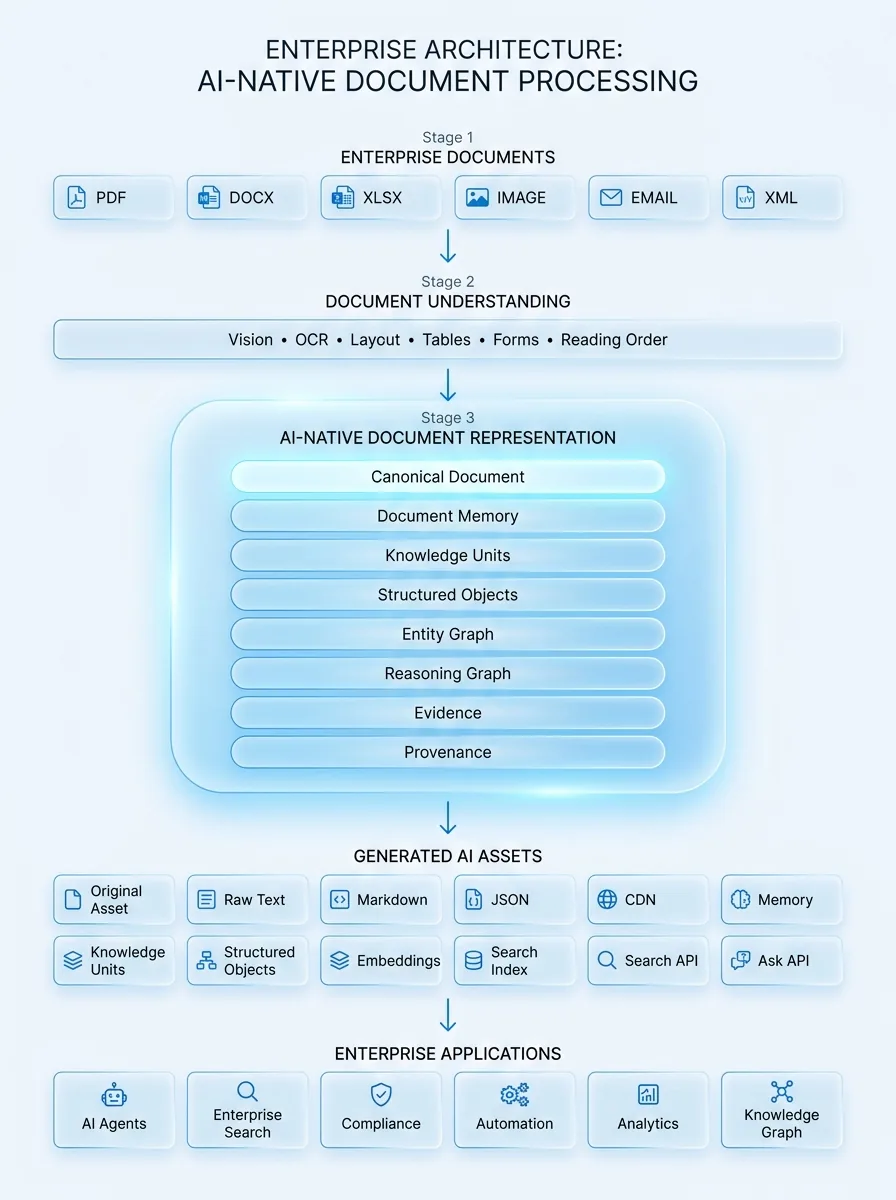
07 — Any input
If it carries information, it becomes a document.
Docsfra doesn't stop at PDFs. Email and audio come in as first-class inputs and get the same representation, the same evidence and the same APIs as any scan.
Documents
PDF, Word, PowerPoint, scans and photos.
.eml files — headers and body parsed into clean markdown.
Audio
mp3, wav, m4a, ogg — and WhatsApp .opus voice notes.
A voice note is a document too
A WhatsApp voice message comes in, gets transcribed with [MM:SS] timestamps, and becomes a searchable, citable, structured record — same representation as everything else.
08 — Where it fits
Powering critical use cases across industries.
Wherever a compliance officer, an auditor or a regulator will ask "prove it" — evidence, determinism and auditability turn document work into a defensible process.
Trade Finance
Before
Teams manually compare L/Cs, invoices, bills of lading and insurance documents for discrepancies.
With Docsfra
Every document is split, structured and cross-checked — with evidence behind each field.
Legal
Before
Contracts are searched as files; clauses and obligations live in people's heads.
With Docsfra
Clauses, obligations, dates and parties become queryable structured objects, linked to source.
Insurance
Before
Claim forms, policies and supporting documents are reviewed by hand, page by page.
With Docsfra
Claims become structured, searchable, evidence-backed workflows.
Enterprise Search
Before
Search returns a list of files and leaves the reading to you.
With Docsfra
Search returns verified answers, source spans and structured context.
Government & Public
Before
Regulations, filings and archives are stored, not queryable.
With Docsfra
Every record becomes searchable and auditable, with a provenance trail.
AI Agents
Before
Agents re-read raw documents on every run and hallucinate the gaps.
With Docsfra
Agents get a persistent, evidence-anchored document memory they can trust.
09 — For developers
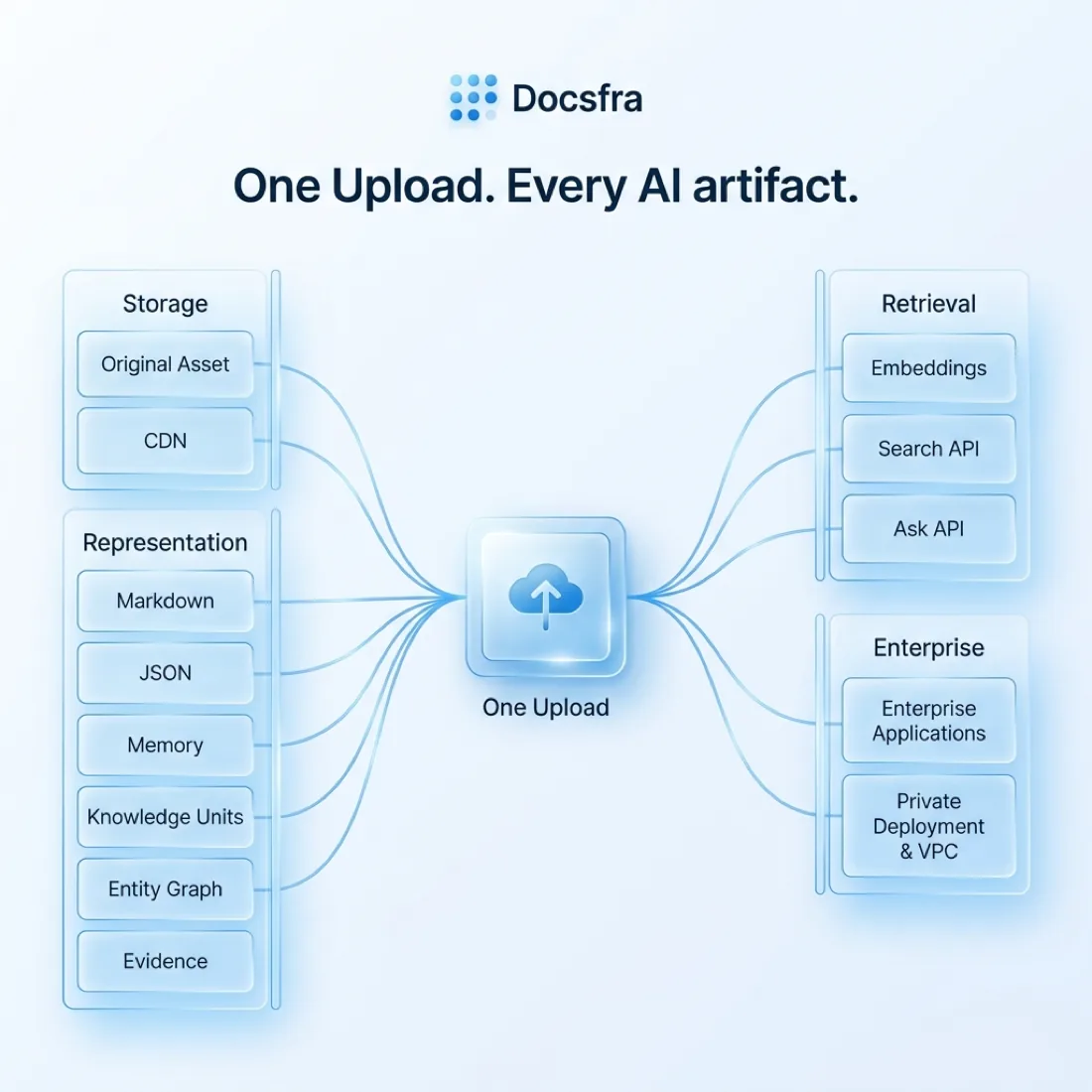
One upload. Production-ready document APIs.
One upload returns media, markdown, JSON, canonical memory, graphs, evidence, embeddings, search and ask APIs — created as one synchronized system.
Request
curl -X POST https://api.docsfra.com/v1/documents \ -H "Authorization: Bearer dip_live_a1b2c3..." \ -F "file=@Contract.pdf"
Response
Generated automatically from one upload.
10 — In the browser
Not only an API. A console your whole team can use.
Every capability on this page is one upload away in the browser — no code. Drop a file, watch it become a representation, open any of the eight layers, search across everything you've uploaded, and ask a question that answers with a citation you can click straight to the page. Built for the analyst, not just the engineer.
Upload & batches
Drag in a file or a whole folder; track every job live.
Layer inspector
Memory, entities, reasoning, tables and evidence — side by side.
Ask with citations
Answers link back to the exact page and box they came from.
Cost per artifact
Every job shows what each artifact actually cost.
“What is the maturity date of this letter of credit?”
The maturity date is 15 September 2026, with a tenor of 270 days after shipment.
11 — Your models, your rules
Use our models, bring your own key — or point us at your own endpoint.
The defaults just work. When you need control, you have three ways to get it — per pipeline lane, without re-processing a thing.
Catalog
Pick any model from the catalog on our keys, billed per token at listed rates.
Your provider key
Bring your own OpenRouter key — model costs go straight to your bill.
Your own endpoint
Any OpenAI-compatible endpoint you run — Azure OpenAI, vLLM, Ollama.
Keys are encrypted at rest, never logged, and every outbound call is guarded against SSRF. Swap models anytime — the representation underneath never re-indexes.
12 — Enterprise control
Security and control are not an add-on.
Tenant isolation at the database layer
Postgres row-level security — every query is scoped to a tenant, enforced by the database itself.
Audit-ready by design
Append-only ledger with a content-hashed provenance chain behind every artifact.
Sovereign deployment
Document parsing runs on our own GPU infrastructure by default — page images are never sent to third-party AI providers; only extracted text reaches the model lanes. Full self-hosted, air-gapped or own-GPU deployment available.
Model independent
Swap LLMs and embedding models freely — the representation layer underneath stays put.
13 — Pricing
Pay for artifacts, not seats.
A credit-based model, billed by the unit of work — no monthly minimum, no per-seat tax. New accounts start with 250 free credits.
Pay as you go
12 modules, one price list. Use only what your pipeline actually runs.
Extraction
unit / page
1.00 credits
Structuring (reasoning)
unit / page
0.50 credits
Embedding
unit / 1K tokens
0.02 credits
Vector indexing
unit / 1K chunk-mo
0.10 credits
Hybrid search
unit / query
0.02 credits
RAG Q&A
unit / query
0.20 credits
Media CDN
unit / GB-mo
0.05 credits
Markdown CDN
unit / GB-mo
0.02 credits
Document Memory
unit / document
0.10 credits
Entity Graph
unit / document
0.15 credits
Reasoning Graph
unit / document
0.15 credits
Layout Model
unit / page
0.05 credits
Sovereign / Enterprise
Self-hosted or air-gapped, on your own GPUs. Dedicated support and custom terms for regulated environments.
- Self-hosted & air-gapped deployment
- Bring your own GPUs
- Dedicated support
- Custom contract terms
What a real job costs
Estimated credits, derived from the rates above — actual usage depends on document length and which artifacts you generate.
10-page contract
≈ 16 creditsExtraction, structuring, entities, memory and embeddings — search & ask ready.
95-page trade finance packet
≈ 150 creditsSplit into 13 documents, 112 tables, entities, verified reasoning, evidence and ask API.
10,000-page archive
≈ 15,000 creditsBatch extraction, structuring, embeddings and hybrid-search indexing.
1 credit = 1 unit of work. Prices in credits.
Bring your own model keys (BYOK) — your models, your bill. Or pick any catalog model on our keys, billed per token at listed rates.
FAQ
Frequently asked questions.
What is an AI-native document representation?
An AI-native document representation (AIDR) is Docsfra's deterministic, evidence-anchored replacement for the document stack. One upload generates eight layers — canonical document, document memory, knowledge units, structured objects, entity graph, reasoning graph, evidence and provenance — and every derived artifact comes from that representation, not from re-running a pipeline.
How is Docsfra different from OCR or a RAG library?
OCR and RAG libraries treat extraction as the end goal, tied to whichever model you plug in. Docsfra treats the representation itself as the product: the engine and models underneath can change, but the representation persists. Every answer is anchored to the page and character span it came from — and, where layout permits, down to the exact bounding box.
What do I get from one upload?
One upload returns 16+ artifacts from a single synchronized pipeline: media and CDN URLs, raw text and markdown, structured JSON, the canonical document, document memory, knowledge units, structured objects, the entity graph, the reasoning graph, evidence, provenance, embeddings, and search and ask APIs.
Can Docsfra run in our own infrastructure?
Yes. Docsfra supports self-hosted, air-gapped and GPU-ready sovereign deployment — your data never has to leave your perimeter. The Sovereign/Enterprise plan adds dedicated support and custom contract terms for regulated environments.
How does pricing work?
Docsfra uses a credit-based, pay-as-you-go model — 1 credit equals 1 unit of work across 12 modules (extraction, structuring, embedding, indexing, search, ask, media and markdown CDN, document memory, entity graph, reasoning graph and layout). There's no monthly minimum and no per-seat pricing. New accounts start with 250 free credits.
Can I choose the models — or bring my own keys?
Yes, and it's entirely optional. Pick any model from the OpenRouter catalog per pipeline lane — custom models on our keys are billed per token at the listed Docsfra model rates. Or bring your own provider key (BYOK) — including any OpenAI-compatible endpoint of your own (Azure OpenAI, vLLM, Ollama…): model costs go on your bill, keys are stored encrypted and never logged, and only the flat artifact rates apply. Leave everything untouched and Docsfra defaults just work.
Final thesis
Stop building document pipelines.
Build AI.
We'll build the infrastructure. You build the products.